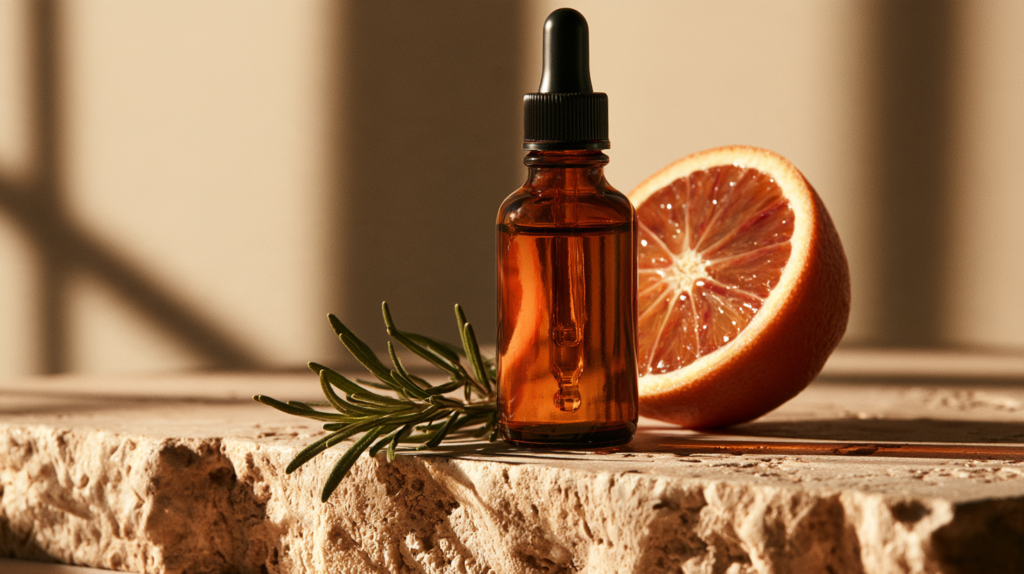
Vitamin C serum is one of the most evidence-supported topical ingredients in dermatology — but also one of the most frequently purchased in ineffective formulations. Patients come to Elect Dermatology in New Braunfels having spent months applying serums that oxidized before they even opened them, or that use vitamin C derivatives too unstable or impotent to deliver meaningful results. This guide explains what actually makes a vitamin C serum work and how to use one correctly.
Why Vitamin C Is Worth Using
L-ascorbic acid (vitamin C) functions in the skin as an antioxidant, a direct cofactor for collagen synthesis enzymes, and a tyrosinase inhibitor (reducing melanin production). Applied topically, it neutralizes reactive oxygen species generated by UV exposure, contributes to collagen maintenance and production, and progressively reduces hyperpigmentation. A comprehensive review by Telang (Indian Dermatol Online J, 2013) summarizes its clinical evidence base. The American Academy of Dermatology lists a vitamin C serum among the dermatologist-recommended additions to a daily routine, and a review by Al-Niaimi and Chiang (J Clin Aesthet Dermatol, 2017) covers its mechanisms of action and clinical applications.
The Formulation Problem: Why Many Products Don’t Work
L-ascorbic acid is inherently unstable. It oxidizes rapidly on exposure to air, light, and water — and once oxidized (the serum turns orange or brown), it has lost its antioxidant and brightening activity. This means a poorly packaged vitamin C serum can be nearly inactive before you ever open it.
Additionally, L-ascorbic acid penetrates skin optimally at an acidic pH — below approximately 3.5. At neutral pH, penetration is significantly reduced. A foundational study by Pinnell et al. (Dermatol Surg, 2001) established the formulation parameters necessary for effective vitamin C delivery: adequate concentration, appropriate pH, and a stabilizing vehicle. Products that don’t meet these criteria — regardless of marketing claims — are unlikely to deliver meaningful results.
What Concentration Is Effective?
The Pinnell research demonstrated that 15–20% L-ascorbic acid represents the optimal concentration range for maximum skin saturation, beyond which additional concentration doesn’t improve efficacy but does increase irritation risk. Concentrations in the 10–15% range are also clinically meaningful and often better tolerated by sensitive skin. Concentrations below 8–10% are generally considered subtherapeutic for significant photoaging benefit, though they may still provide some antioxidant support. Products labeled “vitamin C serum” without specifying concentration or using vague terms like “vitamin C complex” should be viewed skeptically.
Vitamin C Derivatives: Stability vs. Potency Trade-off
Because L-ascorbic acid is difficult to stabilize, many products use derivatives: ascorbyl glucoside, sodium ascorbyl phosphate, magnesium ascorbyl phosphate, tetrahexyldecyl ascorbate, and others. These derivatives are more chemically stable than L-ascorbic acid and less prone to oxidation. The trade-off is that they must be converted to active ascorbic acid in the skin, reducing potency relative to L-ascorbic acid at comparable concentrations. For patients with sensitive skin who can’t tolerate the acidity required for L-ascorbic acid formulations, stable derivatives are a reasonable alternative — just with appropriately adjusted expectations. A 20% ascorbyl glucoside will not match a well-formulated 15% L-ascorbic acid serum for photoaging reversal.
What to Look for in a Vitamin C Serum
When evaluating a vitamin C serum, these are the meaningful indicators of quality: L-ascorbic acid as the primary vitamin C ingredient (not buried in a blend of derivatives); stated concentration of 10–20%; opaque, airless, or dark glass packaging to protect from oxidative degradation; and a formulation pH at or below 3.5 for L-ascorbic acid products. Physician-dispensed brands typically invest more in formulation stability and packaging because their customers are measuring results. Many well-formulated options also exist outside the medical channel — focus on ingredients and packaging rather than where the product is sold.
How to Use Vitamin C Serum Correctly
Apply to thoroughly dry skin each morning — residual moisture dilutes the formula and reduces skin absorption. 3–4 drops is adequate for the full face and neck. Allow the serum to absorb for 2–5 minutes before layering other products. Follow with moisturizer, then SPF 50+ (see our guide to medical-grade vs. drugstore skincare). The combination of topical antioxidant (vitamin C) plus UV protection works synergistically — the antioxidant helps neutralize radicals that sunscreen alone doesn’t block.
Retinoids are typically applied at night while vitamin C is used in the morning, which avoids potential irritation from combining highly active ingredients. However, there is no absolute contraindication to using both in the same routine if skin is tolerating each well independently — it is primarily a practical skin-sensitivity consideration, not a chemical incompatibility.
Avoid applying vitamin C immediately after benzoyl peroxide — the peroxide can oxidize the ascorbic acid, reducing its activity. If you use benzoyl peroxide, apply vitamin C at a different time of day.
Storage and Shelf Life
Once opened, L-ascorbic acid serums should be used within 2–3 months. Store in a cool, dark location — the refrigerator is ideal. If the serum has turned noticeably orange or brown, it has oxidized and lost meaningful activity. Using oxidized vitamin C won’t harm your skin, but it won’t provide the antioxidant or brightening benefits you’re purchasing it for.
When to Combine Vitamin C with Professional Treatment
Daily vitamin C serum is excellent for ongoing maintenance, antioxidant protection, and mild pigmentation improvement. For significant established sun damage, melasma, or advanced photoaging, it works best as part of a broader plan that includes prescription-strength options (tretinoin, hydroquinone) and professional treatments like chemical peels. Our dermatologists can evaluate your skin, identify what will move the needle for your specific concerns, and recommend whether a vitamin C serum alone is sufficient or part of a larger protocol.
References
- Pinnell SR, et al. Topical L-ascorbic acid: percutaneous absorption studies. Dermatol Surg. 2001;27(2):137-142. PubMed
- Telang PS. Vitamin C in dermatology. Indian Dermatol Online J. 2013;4(2):143-146. PubMed
- Al-Niaimi F, Chiang NYZ. Topical vitamin C and the skin: mechanisms of action and clinical applications. J Clin Aesthet Dermatol. 2017;10(7):14-17. PubMed
- American Academy of Dermatology. Dermatologist-recommended skin care for your 20s. AAD.org
Not sure whether your current vitamin C serum is actually working, or whether it’s time to upgrade your routine? The board-certified dermatologists at Elect Dermatology in New Braunfels evaluate your current products, identify gaps, and recommend formulations with the evidence and formulation quality to deliver real results. Call (833) 353-2875 or request an appointment online to schedule your skincare consultation at 2154 Gabriels Pl, Ste 103, New Braunfels, TX 78130.
Reviewed by Dr. Hockley
Schedule Your Dermatology Appointment
Our board certified dermatologists in New Braunfels are here to help. New patients are always welcome.