Full Body Skin Exam in New Braunfels: The 15-Minute Appointment That Could Save Your Life
If you’ve never had a full body skin exam in New Braunfels, you’re not alone — and that’s a problem. The American Academy of Dermatology estimates that one in five Americans will develop skin cancer in their lifetime, making it the most common cancer in the United States. In Texas, where UV exposure is among the highest in the country, that risk is even greater — and yet most adults have never had a professional skin cancer screening.
A full body skin exam is one of the most effective ways to detect skin cancer early, when it’s most treatable. It takes 10 to 15 minutes, it’s painless, it requires no preparation, and it can catch melanoma at a stage when the 5-year survival rate is 99% according to the Skin Cancer Foundation. The reason dermatologists push so hard for regular screenings isn’t because we enjoy giving exams — it’s because we’ve seen what happens when skin cancer is caught late versus early, and the difference is life-changing.
At Elect Dermatology, our board-certified dermatologists perform comprehensive skin cancer screenings for patients across Comal County — from downtown New Braunfels and Gruene to Canyon Lake, San Marcos, Seguin, and the surrounding Hill Country — using dermoscopy and clinical expertise to evaluate every mole, spot, and lesion on your body.
What Happens During a Full Body Skin Exam?
The idea of a full body skin exam makes some patients nervous, but the reality is straightforward and quick. Here’s exactly what to expect when you schedule a full body skin exam in New Braunfels at Elect Dermatology.
Before the exam: You’ll change into a gown. Remove nail polish from fingers and toes if possible — skin cancer can develop under nails. Pull your hair down so your dermatologist can examine your scalp. There’s no other preparation needed.
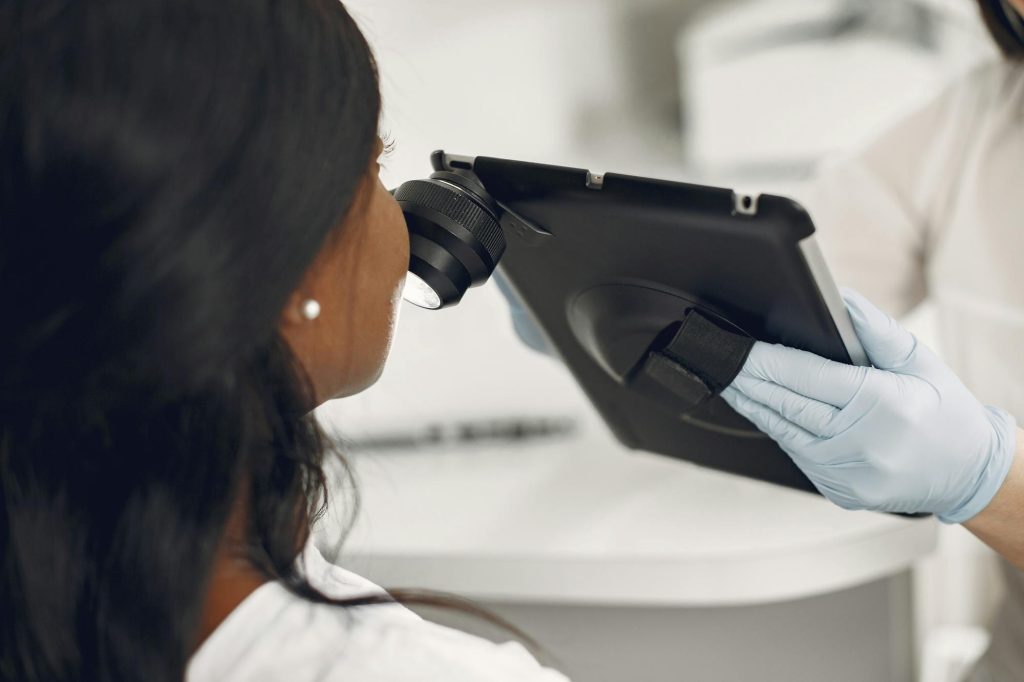
During the exam: Your dermatologist systematically examines your entire skin surface — scalp, face, ears, neck, chest, back, arms, hands (including between fingers and under nails), legs, feet (including soles and between toes), and genital area. The exam uses both the naked eye and a dermoscope — a handheld magnification device with polarized light that reveals structures beneath the skin’s surface invisible to the naked eye. A study published in PMC
demonstrated that dermoscopy improves diagnostic accuracy for melanoma by up to 35% compared to clinical examination alone.
What we’re looking for: Your dermatologist evaluates every mole, freckle, and lesion using the ABCDE criteria — Asymmetry, Border irregularity, Color variation, Diameter greater than 6mm, and Evolving (changing) appearance.
We’re also looking for non-melanoma skin cancers (basal cell carcinoma and squamous cell carcinoma), precancerous lesions called actinic keratoses, and any spots that simply don’t look right based on clinical experience.
If something looks suspicious: Your dermatologist may recommend a biopsy — a quick, in-office procedure where a small sample of skin is removed and sent to a pathology lab for analysis. Most biopsies take less than five minutes, require only local anesthetic, and heal within 1 to 2 weeks. The results typically come back within 7 to 10 days.
After the exam: Your dermatologist will review findings with you, discuss any spots that need monitoring, and recommend a follow-up schedule based on your individual risk factors. Most exams are completed in 10 to 15 minutes.
Why Texans Need Skin Cancer Screenings More Than Most Americans
identifies UV radiation as the primary environmental risk factor for all major types of skin cancer.
Consider the math: if you’ve lived in New Braunfels or Central Texas for 20+ years, you’ve accumulated significantly more cumulative UV exposure than someone who spent those same years in Seattle, Chicago, or Boston. That exposure doesn’t reset — it accumulates in your skin cells over your entire lifetime, and the damage you sustained as a teenager can manifest as skin cancer in your 40s, 50s, or 60s. The Skin Cancer Foundation reports that having five or more sunburns doubles your risk of melanoma.
This is why a full body skin exam in New Braunfels is particularly important for anyone who has spent significant time living in Texas — the cumulative UV damage is higher than you realize, and a professional screening catches what self-exams miss.
Don’t wait for a suspicious spot to appear. Schedule your full body skin exam in New Braunfels with a board-certified dermatologist who catches what you can’t see. Call (833) 353-2875 or request an appointment online.
Who Needs a Full Body Skin Exam — and How Often?
The AAD encourages adults to talk with their dermatologist about whether regular skin cancer screenings are appropriate based on their individual risk factors. Beyond that baseline, your screening frequency depends on your individual risk profile.
Annual screenings are recommended for: anyone with a personal history of skin cancer or precancerous lesions, anyone with a family history of melanoma, patients with more than 50 moles, patients with fair skin who burn easily, anyone with a history of blistering sunburns (especially in childhood), patients who have used tanning beds, organ transplant recipients and immunosuppressed patients, and anyone living in a high-UV environment like Central Texas with significant outdoor exposure.
Every 2-3 years may be sufficient for: patients with darker skin tones and no other risk factors, patients with minimal sun exposure history and no concerning moles, and younger adults with no family history of skin cancer.
Your dermatologist will recommend the right schedule for you based on your specific risk factors. When in doubt, annual screenings are the safest approach — the cost of a yearly exam is trivial compared to the cost of a missed melanoma.
What a Dermatologist Catches That You Can’t
Self-exams are important — the AAD recommends checking your own skin monthly — but they have significant limitations. You physically cannot see your own scalp, back, and many hard-to-reach areas where skin cancer commonly develops. More importantly, you lack the trained eye and diagnostic tools that make professional screening so much more effective.
A board-certified dermatologist has examined thousands of skin lesions and can recognize subtle patterns — a slightly irregular border, a faint color change, a texture difference — that even the most diligent self-examiner would miss. Dermoscopy reveals subsurface structures that are completely invisible to the naked eye. And experience matters: the difference between a benign mole and an early melanoma can be subtle enough that it takes years of clinical training to distinguish them reliably.
This is particularly true for lesions in less obvious locations. Skin cancer on the scalp, between the toes, behind the ears, on the genitals, and under fingernails is frequently missed because patients don’t think to look there — and when they do look, they don’t recognize what they’re seeing. At Elect Dermatology, our physicians examine every square inch, including the places patients forget. The Three Types of Skin Cancer and What They Look Like
Basal cell carcinoma (BCC) is the most common skin cancer and the most common cancer of any kind. It typically appears as a pearly or waxy bump, a flat flesh-colored or brown scar-like lesion, or a bleeding or scabbing sore that heals and returns. BCC grows slowly and rarely spreads to other organs, but it can cause significant local tissue destruction if left untreated. The AAD notes that BCC is most common on sun-exposed areas like the face, neck, and ears.
Squamous cell carcinoma (SCC) is the second most common skin cancer. It often presents as a firm red nodule, a flat lesion with a scaly or crusted surface, or a new sore or raised area on an old scar. SCC can spread to lymph nodes and distant organs if not treated promptly, particularly in immunosuppressed patients. In Texas, actinic keratoses — rough, scaly precancerous patches caused by cumulative sun damage — are extremely common and can progress to SCC if left untreated.
Melanoma is the deadliest form of skin cancer, accounting for the majority of skin cancer deaths despite being less common than BCC or SCC. It can develop in an existing mole or appear as a new, unusual-looking spot. The Skin Cancer Foundation
reports that the 5-year survival rate for melanoma detected early (before it spreads) is 99% — but that number drops dramatically once it reaches the lymph nodes or distant organs. This is why screening matters: early detection is the difference between a simple office procedure and a fight for your life.
Frequently Asked Questions About Skin Exams in New Braunfels
Does insurance cover a full body skin exam? Most insurance plans cover an annual skin cancer screening as preventive care. If a biopsy is needed, it’s typically covered as a diagnostic procedure. Our staff at Elect Dermatology will verify your specific coverage before your appointment.
How should I prepare for my skin exam? Remove nail polish from fingers and toes. Wear your hair down. Avoid heavy makeup on the face so your dermatologist can see your skin clearly. That’s it — no other preparation is needed.
Will the exam be uncomfortable or embarrassing? The exam is completely painless. Your dermatologist is professional and respectful — this is routine medical care, not unlike a physical exam. You can keep underwear on if preferred, though skin cancer can develop anywhere, and a complete exam includes all skin surfaces.
I have dark skin — do I still need a skin exam? Yes. While skin cancer is more common in fair-skinned individuals, it occurs in all skin types — and it’s often diagnosed at later, more dangerous stages in patients with darker skin because both patients and providers may not expect it. Melanoma in darker-skinned patients frequently develops in less sun-exposed areas like the palms, soles of the feet, and under the nails.
My moles haven’t changed — do I still need screening? Yes. Many skin cancers — including melanoma — can arise as entirely new lesions rather than from existing moles. Your dermatologist also has the training to detect subtle changes you may not notice and to evaluate lesions in areas you can’t easily examine yourself.
Schedule Your Full Body Skin Exam in New Braunfels Today
A full body skin exam in New Braunfels takes 15 minutes and could be the most important appointment you make this year. Skin cancer caught early is almost always curable — but you can’t catch what you don’t look for, and you can’t see what a dermatologist with a dermoscope can see.
At Elect Dermatology, Dr. Hockley and Dr. Stahr perform thorough, unhurried skin cancer screenings using dermoscopy and decades of combined clinical experience. If we find something concerning, we can biopsy it the same day — no additional appointments, no waiting, no worrying.
New patients are welcome, and we’re currently accepting same-week appointments.
Call us today at (833) 353-2875 or request an appointment online. We’re conveniently located at 2154 Gabriels Pl, Ste 103, New Braunfels, TX 78130 — serving patients from across Comal County, including San Marcos, Seguin, Canyon Lake, Schertz, and the greater San Antonio area.
Schedule Your Dermatology Appointment
Our board certified dermatologists in New Braunfels are here to help. New patients are always welcome.