Call us today at (833) 353-2875 to schedule a consultation.
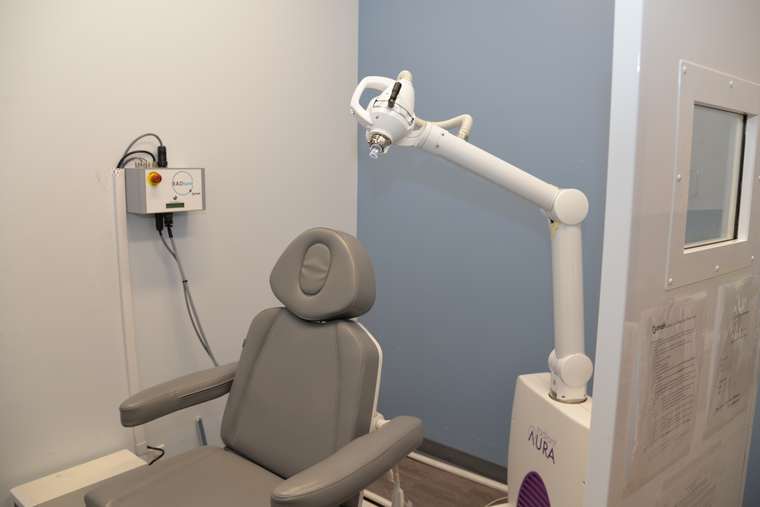
For many patients with non-melanoma skin cancer — especially those with lesions in cosmetically sensitive areas, elderly or medically complex patients, or anyone who simply wishes to avoid a scalpel — radiation therapy offers a clinically proven, non-surgical option. At Elect Dermatology we treat eligible patients on the Xstrahl RADiant Aura, delivering both electronic brachytherapy (EBT) and superficial radiation therapy (SRT) in our New Braunfels office.
Published cure rates for well-selected lesions run 90–95%, treatment is typically covered by Medicare, and there is no cutting, no stitches, and no downtime.
What Is Electronic Brachytherapy?
Electronic brachytherapy (EBT) is a non-surgical treatment that delivers a precisely calibrated, low-energy X-ray dose to a skin lesion over a short course of in-office sessions. The word brachytherapy means “short-distance therapy” — the energy drops off sharply just beyond the lesion, sparing deeper tissues such as muscle, cartilage, nerves, and bone while treating the tumor at the surface.
EBT is FDA-cleared for the treatment of non-melanoma skin cancer and is the more common of the two modalities at our practice.
What Is Superficial Radiation Therapy?
Superficial radiation therapy (SRT) uses a focused, low-energy X-ray beam delivered from an external device and aimed at a precisely defined treatment field on the skin. Our SRT service operates at 50–100 kilovoltage (kVp). The beam penetrates only a few millimeters, treating abnormal cells while leaving deeper tissue untouched.
SRT has been used in dermatology for more than 70 years and is recognized in the American Academy of Dermatology’s appropriate-use criteria. For larger treatment fields or certain anatomic locations, SRT may be the recommended approach.
Why We Begin With an Ultrasound
A skin cancer is three-dimensional. The part visible on the surface is often the smallest piece of the tumor — most of the abnormal cells sit in a dome or column of tissue beneath it.
Before designing your treatment course, we perform a diagnostic ultrasound of the lesion at your initial consultation. The ultrasound measures the tumor’s depth and maps its margins, so the dose and field are planned around what is actually there rather than what is visible to the naked eye. This planning step is performed once, at the start of the course, and informs the protocol for every subsequent session.
How Radiation Treats Skin Cancer
EBT and SRT work on the same biological principle — the delivery method is what differs. Skin cancer cells divide more rapidly than healthy skin cells, which makes them especially vulnerable to targeted radiation. A precisely calibrated dose:
- Damages the DNA of malignant cells, triggering their death
- Halts the uncontrolled cell division that drives tumor growth
- Leaves surrounding healthy tissue largely untouched
- In keloid cases, suppresses the fibroblast over-activity that causes recurrence
Because both modalities are low-energy and focused on the skin surface, patients experience no incision, no stitches, no sedation, and no downtime.
Conditions We Treat
Basal Cell Carcinoma
The most common skin cancer. Superficial and nodular basal cell carcinomas on the trunk and extremities, and well-selected facial BCCs, respond well to EBT and SRT, with published cure rates of 90–95% in the peer-reviewed literature.
Squamous Cell Carcinoma
The second most common skin cancer. Radiation is appropriate for low-risk, well-differentiated primary squamous cell carcinomas in patients for whom surgery is not ideal. High-risk or deeply invasive SCCs are typically better managed with Mohs surgery.
Keloid Prevention After Excision
One of the most effective uses of radiation in dermatology. A short course — typically 1–3 fractions delivered within 24 to 72 hours after surgical excision of a keloid — can reduce recurrence to single digits, a dramatic improvement over excision alone, which recurs in 50–80% of high-risk cases. This is particularly valuable for keloids of the ear, chest, and shoulder.
Who Is a Good Candidate?
Radiation therapy is an excellent option for many, but not every, patient. You may be a strong candidate if you have:
- A biopsy-confirmed non-melanoma skin cancer
- A lesion in a cosmetically sensitive area such as the nose, ear, eyelid, or lip
- An elderly or medically complex situation that makes surgery risky
- Anticoagulation that cannot be safely interrupted
- A strong personal preference to avoid surgery
- A keloid being surgically excised, where radiation immediately afterward prevents recurrence
When Radiation Is Not the Right Choice
We believe in giving you the full picture. Radiation therapy is not appropriate for:
- Melanoma, which requires surgical excision or medical oncology referral
- High-risk, recurrent, or deeply invasive tumors — Mohs surgery remains the gold standard
- Tumors with perineural or bone invasion
- Patients under 40, given long-term radiation exposure considerations
- Certain genetic conditions such as basal cell nevus syndrome
At your consultation we review your biopsy, the location, and your medical history, then recommend the approach that gives you the best outcome — whether that is EBT, SRT, Mohs surgery, standard excision, or something else.
What to Expect During Treatment
Consultation and Planning
We review your biopsy, examine the lesion, and perform the diagnostic ultrasound. We then develop a dose protocol specific to your case and verify your insurance benefits before treatment begins.
Each Session
You sit or lie comfortably while the surrounding skin is shielded. The beam is positioned and treatment runs for a few minutes. There is no sensation during the beam. Typical in-and-out time is 15 to 20 minutes.
Course Length
At Elect Dermatology, both EBT and SRT courses typically run 16 to 21 sessions over approximately four weeks. Your dermatologist tailors the exact number of fractions to your lesion, its depth, and your response over the course of treatment. Keloid prevention is far shorter — 1 to 3 fractions in the first 24 to 72 hours after excision.
Side Effects and Recovery
Because both modalities are low-energy and focused on the skin surface, side effects are localized to the treatment field.
Most patients feel nothing during a session — no pain and no heat. Toward the end of the course, the treated area may develop pink-to-red discoloration (radiation dermatitis), mild dryness, or small areas of crusting; we provide a specific skincare protocol to minimize this. After completion, the area heals over two to four weeks. Long term, skin in the treated field may appear slightly lighter or darker than the surrounding skin, and small superficial blood vessels can sometimes become visible. Serious complications are rare with dermatologist-delivered protocols.
Insurance and Medicare Coverage
Medicare covers both electronic brachytherapy and superficial radiation therapy for biopsy-confirmed non-melanoma skin cancer when medically appropriate, and for post-excision keloid prevention in appropriate cases. Most commercial plans follow similar criteria. Before your course begins, our team verifies your benefits, handles any prior authorization, and provides a written out-of-pocket estimate.
EBT or SRT — Which Will I Receive?
Both are non-surgical, both run 16 to 21 sessions over about four weeks, and both carry 90–95% published cure rates for appropriate lesions. EBT delivers a calibrated dose to a small, clearly defined lesion and is our more common modality. SRT’s external beam covers larger or irregularly shaped fields. The recommendation depends on your biopsy, lesion size, location, and medical history — and because we operate both on the same platform, that recommendation is clinical rather than a function of what happens to be in the building.
Radiation Therapy Compared With Mohs Surgery
Both are effective, and both are appropriate for the right patient. Mohs micrographic surgery removes the tumor layer by layer with immediate microscopic review, carries the highest published cure rates (roughly 99% for primary BCC and SCC), is usually completed in a single day, and remains the gold standard for high-risk, recurrent, or deeply invasive tumors. It requires local anesthesia and leaves a surgical scar, which often heals well.
Radiation involves no cutting, no anesthesia, and no interruption of blood thinners, and it is frequently preferred in cosmetically sensitive areas and for elderly or medically complex patients — at the cost of a four-week course of visits. The right answer depends on your tumor, not on what a practice happens to offer.
Why Choose Elect Dermatology
At Elect Dermatology you see a board-certified dermatologist from your initial biopsy through the last day of treatment and every annual skin check afterward. There is no hand-off to a separate radiation oncology practice, no imaging-center visits, and no weeks-long wait to begin.
We apply protocols consistent with AAD and NCCN appropriate-use guidance, and we are honest about when radiation is the right choice and when it is not. We serve New Braunfels, San Antonio, San Marcos, Seguin, Canyon Lake, Boerne, Schertz, and the surrounding Central Texas communities.
Frequently Asked Questions
Is this the same as the radiation used for breast or prostate cancer?
No. Those cancers are treated with high-energy radiation that penetrates deep into the body. EBT and SRT use low-energy X-rays that reach only a few millimeters into the skin. The dose, the equipment, and the biological effect are all very different.
Will radiation therapy increase my risk of other cancers?
The lifetime secondary-cancer risk is considered low, because the dose is confined to the skin surface and a small treatment field. This is one reason office-based radiation is generally reserved for patients over 40 and discussed carefully with younger candidates.
Do I need a referral?
No referral is required. Many patients come to us directly after an outside biopsy, or during a routine skin check when a suspicious lesion is found. If you have an outside biopsy report, we are happy to review it.
Can I drive myself home after a session?
Yes. There is no sedation and no recovery period. You can drive yourself to and from treatment and return to work, exercise, and normal activities immediately.
Will the treated area look normal afterward?
In most cases the long-term cosmetic result is very good, particularly compared with a surgical scar in the same location. Some patients develop a slight change in pigmentation or small visible blood vessels in the treatment field. We review realistic expectations with you before starting.
Can radiation be used again if cancer returns in the same spot?
Retreatment of previously irradiated skin is generally not recommended because of cumulative dose concerns. Recurrences in a treated field are typically managed with Mohs surgery or excision.
Schedule a Consultation in New Braunfels
If you have been told you have a basal cell or squamous cell carcinoma, or you are considering surgical removal of a keloid, it is worth knowing whether electronic brachytherapy or superficial radiation therapy fits your case. Our board-certified dermatologists will give you a straight answer.
Call (833) 353-2875 or request an appointment online. You can also learn more about our full range of skin cancer treatment options.